
 For Laboratory Use Only: Intended strictly for research & development, and quality control purposes by qualified personnel only. Not for human or animal consumption, or for any medical, therapeutic, or diagnostic use.
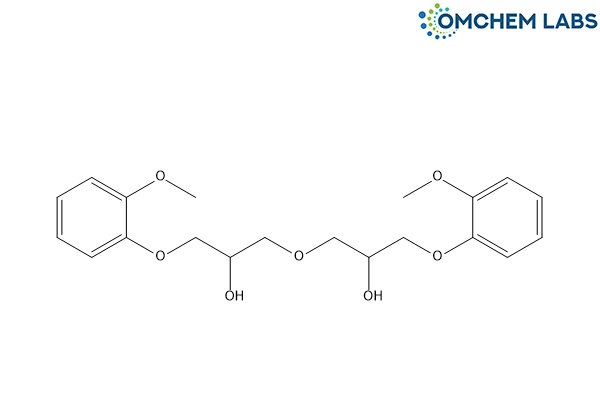
Guaifenesin Impurity C
| Catalogue No |
GUAI-OCL-003 |
| CAS NO |
1797132-23-0 |
| Molecular Formula | C20H26O7 |
| Molecular weight | 378.42 |
| Inquiry Status | In Stock |
| Synonyms | 1,1-oxybis[3-(2-methoxyphenoxy)propane]-2-ol |
Detailed Overview of this Impurity: Discover more about Impurity Standard & Analysis
Impurity Profiling of Guaifenesin Impurity C: Formation, Analytical Evaluation, Purification and Characterization
Introduction
Impurity profiling is an important element of pharmaceutical quality assessment because it provides a systematic understanding of substances that may accompany an active pharmaceutical ingredient or arise during its manufacture and storage. In the case of Guaifenesin Impurity C, evaluation of the impurity profile requires consideration of the chemical characteristics of guaifenesin, possible process-related transformations, degradation pathways, and the analytical behavior of related substances. Published analytical studies have demonstrated that guaifenesin can be evaluated using chromatographic methods capable of separating the parent compound from related impurities and degradation products.
A scientifically appropriate impurity-profiling strategy combines knowledge of the synthetic process with analytical detection, structural interpretation, method validation, purification, and impurity isolation. This integrated approach allows Guaifenesin Impurity C to be examined not simply as an additional chromatographic peak, but as a defined chemical entity whose origin, identity, and behavior can be evaluated within the broader quality-control framework.
Formation of Impurities During API Synthesis
Impurities associated with guaifenesin may originate from several stages of chemical processing. During synthesis, incomplete conversion of starting materials, competing reaction pathways, secondary transformations, and interactions between intermediates can contribute to the formation of related substances. Process conditions can influence these pathways, particularly where multiple functional groups are capable of participating in chemical reactions.
Guaifenesin also contains structural features that can contribute to the formation of related substances through chemical transformation. Depending on the manufacturing environment, impurities may arise through reactions involving the aromatic ether functionality or the polyol portion of the molecule. Process-related substances may subsequently remain associated with the desired material if separation conditions are not sufficiently selective.
Impurity formation does not necessarily end when synthesis is complete. Chemical changes can also occur during downstream processing, storage, or handling. Exposure to environmental factors such as moisture, oxygen, temperature, or light may influence the stability of susceptible compounds and generate degradation-related substances. Consequently, an effective impurity profile should consider both impurities originating from the manufacturing route and those that may develop during the lifecycle of the material.
For Guaifenesin Impurity C, understanding the relationship between the impurity and the parent compound is particularly useful when developing an impurity-control strategy. Literature concerning guaifenesin has reported several related substances, including degradation and process-related impurities, demonstrating the importance of distinguishing individual components within the overall impurity profile.
Analytical Data Interpretation Techniques
Analytical characterization forms the foundation of impurity profiling. Chromatographic techniques are commonly used to establish the separation pattern of guaifenesin and its associated substances. Reversed-phase high-performance liquid chromatography can provide a useful platform for assessing related compounds, while complementary analytical techniques may be required when chromatographic separation alone does not provide sufficient information about an unknown component. Research on guaifenesin has demonstrated the application of stability-indicating liquid chromatographic procedures for examining related substances and degradation products.
Interpretation of chromatographic data involves more than observing the appearance of additional peaks. Retention behavior can provide an initial indication that a component differs from the parent substance, while comparison with qualified reference materials can assist in assigning known impurities. When an unknown component requires further investigation, mass spectrometry can provide information about its molecular characteristics. Nuclear magnetic resonance spectroscopy and infrared spectroscopy can subsequently contribute to structural elucidation when sufficient isolated material is available.
The use of complementary analytical techniques is particularly valuable when structurally related substances exhibit similar chromatographic behavior. Hyphenated approaches such as LC-MS have become important tools in pharmaceutical impurity profiling because chromatographic separation can be combined with mass-based structural information.
Interpretation should therefore be performed as a coherent analytical exercise, integrating chromatographic behavior, spectral evidence, reference-standard comparison, and knowledge of plausible synthetic or degradation pathways. This approach helps distinguish genuine chemical impurities from analytical artifacts and supports more reliable impurity identification.
Method Validation for Impurity Detection
Analytical methods used for impurity profiling must demonstrate that they are suitable for their intended purpose. ICH guidance describes analytical procedure validation as a means of establishing that an analytical procedure can reliably perform its intended function, with appropriate performance characteristics selected according to the purpose of the method.
For Guaifenesin Impurity C, method validation should address characteristics relevant to impurity detection and quantification. Specificity is important because the analytical procedure should distinguish the impurity from guaifenesin, other related substances, degradation products, and potential matrix components. Precision evaluates the consistency of the analytical response, while accuracy establishes the closeness of measured results to an appropriate reference or accepted value.
Other validation considerations include linearity or response behavior over the intended analytical range, sensitivity, robustness, and suitable detection capability. The appropriate validation design depends on whether the procedure is being used for qualitative detection, impurity quantification, release testing, stability assessment, or another defined purpose. ICH Q2 specifically addresses validation of analytical procedures used for impurity testing and emphasizes demonstrating that the procedure is fit for its intended application.
A validated analytical procedure therefore provides the foundation for dependable impurity profiling. Without adequate validation, differences between batches or analytical observations may be difficult to distinguish from normal analytical variability.
Purification Strategies for Reducing Impurities
Purification is an important component of impurity control because analytical detection alone does not remove unwanted substances from the pharmaceutical material. The selection of a purification approach depends on the physicochemical differences between the desired compound and the associated impurities.
Crystallization can be useful when differences in solubility, solid-state behavior, or crystallization tendency allow the desired material to be selectively separated. Liquid-liquid extraction may provide another separation pathway where the distribution characteristics of the compounds differ between solvent phases. Chromatographic purification can be particularly useful when structurally similar substances require higher separation selectivity.
The purification strategy should be designed with consideration of both impurity removal and preservation of the desired material. Excessively aggressive processing may introduce additional degradation or process-related substances, while insufficient purification can allow closely related compounds to remain in the final material. Consequently, impurity profiling and purification development are closely connected activities.
For Guaifenesin Impurity C, analytical monitoring can be used to evaluate whether a selected purification operation changes the composition of the related-substance profile. Such information can help establish a rational relationship between processing conditions and impurity control rather than relying solely on final-product testing.
Isolation and Characterization of Impurities
When an impurity requires definitive identification, isolation may be necessary before detailed structural characterization. Analytical-scale observations can establish that a component is present, but isolated material allows more comprehensive examination using orthogonal techniques.
Preparative liquid chromatography is one possible approach for obtaining an impurity fraction when the impurity and parent compound can be adequately separated. Other separation approaches may be considered according to polarity, solubility, volatility, and chemical stability. The isolated fraction should subsequently be examined using complementary spectroscopic and analytical techniques.
Mass spectrometry can provide molecular-mass and fragmentation information, while nuclear magnetic resonance spectroscopy can provide structural information regarding the chemical environment of the constituent atoms. Infrared spectroscopy may provide additional information concerning functional groups. Combining these techniques with chromatographic comparison can provide a stronger basis for structural assignment than reliance on a single analytical measurement.
For Guaifenesin Impurity C, isolation and characterization can also support the preparation or qualification of an impurity reference material where appropriate. A well-characterized reference material can subsequently assist in confirming identity and supporting routine analytical evaluation. ICH Q3A emphasizes scientific assessment of actual and potential impurities arising from synthesis, purification, and storage, together with appropriate analytical studies for their characterization and control.
Conclusion
The impurity profiling of Guaifenesin Impurity C represents an integrated analytical and pharmaceutical-quality activity involving impurity formation assessment, chromatographic evaluation, structural interpretation, analytical method validation, purification, and impurity isolation. Understanding how related substances may originate during synthesis and subsequent processing provides the basis for developing an appropriate impurity-control strategy.
Analytical techniques establish the impurity pattern, while complementary spectroscopic approaches can support structural identification when required. Validation demonstrates that the selected analytical procedure is suitable for its intended purpose, whereas purification and isolation provide practical means of controlling and investigating individual components of the impurity profile. Together, these activities contribute to a scientifically justified understanding of Guaifenesin Impurity C and support consistent pharmaceutical quality.
The same scientific framework can be adapted to other pharmaceutical impurity standards, provided that the discussion is appropriately tailored to the chemical characteristics, manufacturing pathway, known related substances, and analytical behavior of each individual compound.