
 For Laboratory Use Only: Intended strictly for research & development, and quality control purposes by qualified personnel only. Not for human or animal consumption, or for any medical, therapeutic, or diagnostic use.
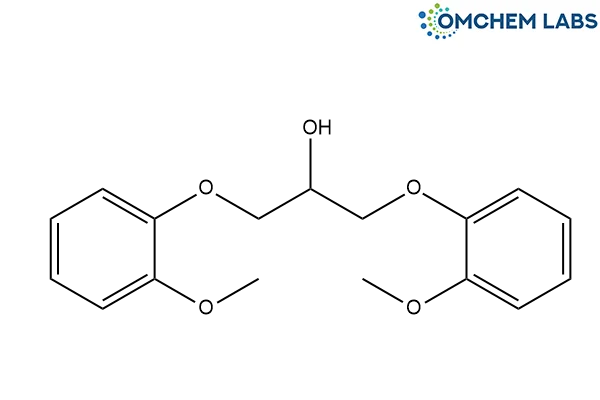
Guaifenesin Impurity D
| Catalogue No |
GUAI-OCL-004 |
| CAS NO |
16929-60-5 |
| Molecular Formula | C17H20O5 |
| Molecular weight | 304.34 |
| Inquiry Status | In Stock |
| Synonyms | 1,3-Bis(2-methoxyphenoxy)-2-propanol |
Detailed Overview of this Impurity: Discover more about Impurity Standard & Analysis
Impurity Profiling of Guaifenesin Impurity D: Formation, Analytical Evaluation, Purification, and Characterization
Introduction
Impurity profiling is an important element of pharmaceutical quality assessment because it provides a systematic approach for understanding substances that may be associated with an active pharmaceutical ingredient or its manufacturing process. Guaifenesin Impurity D can be evaluated within this broader analytical framework to establish its identity, behavior, and relationship to the manufacturing and stability profile of guaifenesin-related materials. A comprehensive impurity profile combines knowledge of the synthetic pathway with suitable chromatographic and spectroscopic techniques to detect, investigate, and characterize related substances.
The assessment of an impurity standard is not limited to its detection. It also involves understanding possible routes of formation, distinguishing process-related substances from degradation products, interpreting analytical signals, and establishing reliable analytical procedures. Published analytical studies of guaifenesin have demonstrated the application of liquid chromatographic methods for evaluating related substances and degradation products, including the use of stability-indicating approaches.
For Guaifenesin Impurity D, an integrated impurity-profiling strategy can therefore provide useful information for analytical development, quality control, process understanding, and characterization of related substances.
Formation of Impurities During API Synthesis
Impurities associated with pharmaceutical manufacturing can originate from several stages of an API synthesis. During the preparation of guaifenesin-related materials, potential sources may include starting materials, reaction intermediates, incomplete conversions, competing chemical reactions, residual reagents, solvents, and process-related by-products. The chemical environment of each synthetic step can influence the formation and persistence of such substances.
Process parameters may also affect the impurity profile. Variations in reaction conditions, reagent quality, reaction progression, work-up procedures, and purification operations can alter the relative occurrence of related substances. An impurity may therefore arise directly from a synthetic transformation or remain as a carryover substance from an earlier stage of manufacturing.
In addition to process-related impurities, degradation pathways should be considered when establishing an impurity profile. Exposure to environmental or processing conditions can potentially produce chemical changes in pharmaceutical substances. Factors such as moisture, temperature, light, oxygen, and chemical environment may contribute to degradation depending on the structural characteristics of the material. Consequently, impurity investigations commonly consider both manufacturing-related and degradation-related sources.
For Guaifenesin Impurity D, understanding its possible origin requires correlation of chromatographic observations with the synthetic route, starting materials, intermediates, process conditions, and stability behavior. This approach provides a more scientifically meaningful assessment than relying solely on the presence of an individual chromatographic peak.
Analytical Data Interpretation Techniques
Analytical data interpretation is central to accurate impurity profiling. Chromatographic techniques, particularly liquid chromatography, can provide separation between the principal compound and associated substances, allowing individual components of a sample to be examined. Published research on guaifenesin has demonstrated the usefulness of stability-indicating liquid chromatographic procedures for evaluating related compounds and degradation products.
Chromatographic interpretation generally involves assessment of retention behavior, peak separation, peak response, and comparison with appropriate reference materials. Where an impurity standard such as Guaifenesin Impurity D is available, comparison with the reference material can assist in establishing identity and supporting analytical assignment. However, chromatographic similarity alone may not always provide complete structural confirmation.
Mass spectrometry can provide complementary information through molecular-mass and fragmentation characteristics, while spectroscopic techniques such as nuclear magnetic resonance and infrared spectroscopy can provide additional structural information when sufficient isolated material is available. The combination of orthogonal analytical techniques strengthens impurity identification because different analytical principles provide complementary evidence.
Interpretation should therefore consider the complete analytical profile rather than an isolated result. Chromatographic separation, spectral characteristics, reference-standard comparison, forced-degradation observations, and knowledge of the synthetic pathway can collectively contribute to a scientifically supported impurity assignment.
Method Validation for Impurity Detection
A reliable impurity profile depends on an analytical procedure that is demonstrated to be suitable for its intended purpose. Current ICH Q2(R2) guidance addresses validation of analytical procedures used for purposes including impurity testing and quantitative measurements. Relevant performance characteristics can include specificity, accuracy, precision, and an appropriate analytical range, depending on the objective of the procedure.
Specificity is particularly important in impurity analysis because the analytical procedure should distinguish the impurity of interest from the principal substance, other related substances, degradation products, and potential matrix components. For chromatographic procedures, this may involve demonstrating adequate separation and absence of relevant interference. ICH Q2(R2) describes approaches including impurity spiking, comparison with orthogonal procedures, and appropriate stressed samples where applicable.
Precision evaluates the consistency of analytical measurements, while accuracy assesses the closeness of results to an accepted reference or appropriately characterized value. Depending on the intended application, calibration behavior, analytical range, detection capability, and robustness may also require consideration. The validation strategy should be scientifically justified according to the purpose of the analytical procedure rather than applying identical validation requirements to every type of test.
For Guaifenesin Impurity D, a properly validated analytical procedure can provide greater confidence that the impurity can be detected, distinguished, and evaluated consistently during pharmaceutical quality assessment.
Purification Strategies for Reducing Impurities
Purification is an important component of impurity control because analytical identification alone does not remove an undesired substance from the manufacturing process. The appropriate purification strategy depends on the chemical and physical differences between the desired material and associated impurities.
Crystallization can be useful when differences in solubility or solid-state behavior allow the desired compound to be selectively separated. Liquid-liquid extraction may exploit differences in partitioning characteristics, while other separation techniques can be selected according to volatility, polarity, solubility, or chemical stability. Chromatographic purification may be particularly useful when closely related substances exhibit sufficiently different retention characteristics.
An effective purification process should be considered together with process understanding. Removing an impurity at a later stage may be possible, but controlling its formation earlier in the synthesis can provide a more efficient impurity-control strategy. Therefore, impurity profiling can support process development by identifying stages where formation or carryover of related substances should be investigated.
For materials associated with Guaifenesin Impurity D, purification decisions should be based on experimentally established chemical behavior rather than assuming that a single purification technique will be appropriate for all manufacturing circumstances.
Isolation and Characterization of Impurities
Isolation provides an important bridge between impurity detection and structural characterization. When an impurity requires further investigation, an appropriate separation procedure may be used to obtain material sufficiently enriched for characterization. Preparative liquid chromatography and other suitable separation techniques can be selected according to the properties of the impurity and the sample matrix.
Following isolation, structural characterization may involve complementary analytical techniques. Mass spectrometry can provide information useful for molecular identification, while nuclear magnetic resonance spectroscopy can contribute detailed structural information. Infrared spectroscopy may provide additional evidence regarding functional groups and chemical composition. Combining multiple analytical techniques can provide stronger structural evidence than relying on a single analytical result.
The use of a characterized impurity reference standard can further support routine analytical testing. Such standards may be useful for comparison during method development, system suitability assessment, impurity identification, and ongoing quality-control investigations, where appropriate.
For Guaifenesin Impurity D, isolation and characterization should be approached as a structured analytical investigation in which chromatographic behavior, spectral evidence, chemical knowledge, and reference-standard information are evaluated together.
Conclusion
Impurity profiling of Guaifenesin Impurity D represents a multidisciplinary analytical process involving synthetic-process understanding, chromatographic evaluation, analytical-data interpretation, method validation, purification, and structural characterization. A scientifically developed impurity-control strategy considers how related substances may arise, how they can be detected and differentiated, and how appropriate analytical procedures can provide reliable information about their presence.
The combination of chromatographic techniques with complementary spectroscopic approaches can strengthen impurity identification, while appropriate analytical validation establishes confidence in the resulting measurements. Purification and isolation studies further contribute to understanding and controlling related substances within the pharmaceutical manufacturing process.
Overall, the evaluation of Guaifenesin Impurity D should be based on scientifically justified analytical procedures and product-specific knowledge. This integrated approach supports consistent pharmaceutical quality and provides a structured foundation for impurity characterization and control throughout the API development and manufacturing lifecycle.